Signal vs WhatsApp: Continuity, Data Control and Compliance
Comparing Signal and WhatsApp on account continuity, data control, and legal compliance under GDPR, the EU Data Act, NIS2, and POPIA.
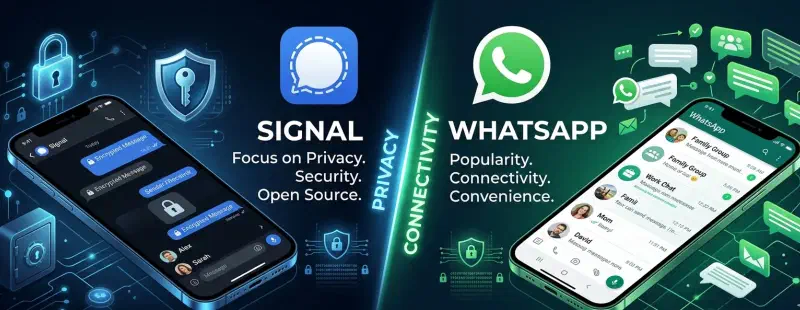
What is Signal?
Signal is a free, open-source messaging application built by the Signal Foundation, a non-profit organization. It operates without advertising and is funded through donations and grants. The platform is available across Android, iOS, Windows, macOS, and Linux. While WhatsApp licenses Signal’s encryption protocol, the two applications differ significantly in their surrounding features and design philosophy.
Continuity: You Can Lose Access Overnight
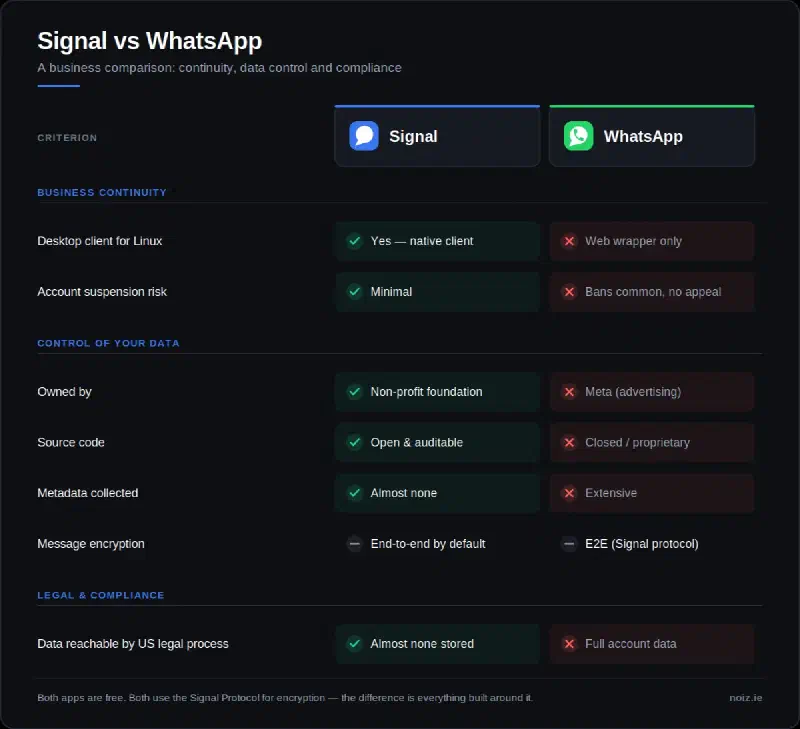
WhatsApp binds user accounts to a single physical device, creating two potential failure points.
First, WhatsApp regularly suspends or locks accounts, sometimes without transparent justification or meaningful appeal options. Account suspension results in immediate loss of chat history and communication channels—a critical vulnerability for business operations.
Second, the platform ties account identity to a specific phone. Device loss, theft, or damage immediately cuts off access. While WhatsApp offers linked devices, these function as secondary connections dependent on the primary phone remaining functional. Linux users face additional limitations, with only web-based wrapper tools available rather than proper desktop clients with full chat history preservation.
Signal takes a different approach. Signal Desktop operates as a genuine native application for Windows, macOS, and Linux—not a browser wrapper—preserving full chat history on desktop systems. Linked Signal desktop clients continue functioning during phone offline periods. Signal is actively developing a fully independent desktop client requiring no phone connection. This architecture ensures access to conversations remains independent of any single device’s operational status.
Data Control: Your Data Is Not in Your Hands
Meta owns WhatsApp, a corporation whose fundamental business model centers on advertising. While message content receives encryption, the surrounding metadata—contact patterns, communication timing, frequency, and location—operates without equivalent protection. Metadata alone reveals operational relationships, client networks, and work patterns. Meta’s privacy policies explicitly permit WhatsApp data sharing across the broader Meta organization. Entrusting client communication to an advertising-focused company creates fundamental confidentiality compromises.
Signal operates on opposing principles. All messages, calls, and files use end-to-end encryption by default with no unencrypted fallback option. Critically for business operations, Signal collects minimal data. Following a U.S. grand jury subpoena, “the only data it could produce was the date the account was created and the date it last connected.” The Sealed Sender feature prevents even Signal’s servers from identifying message participants.
Open-source architecture makes these claims independently verifiable. Both client and server code remain publicly available for independent security audits. Researchers can and regularly do examine Signal’s implementation. WhatsApp’s closed codebase requires trusting vendor security claims without verification. Organizations with stringent requirements can route traffic through personal proxy servers.
Compliance: Where It Becomes a Legal Problem
This analysis extends beyond operational best practices into legal exposure territory.
Meta’s U.S. incorporation places WhatsApp under the 2018 CLOUD Act, permitting U.S. authorities to compel data access regardless of physical server location—including infrastructure within the EU. This directly conflicts with GDPR requirements. Data residency differs fundamentally from data sovereignty; EU-hosted data controlled by U.S. corporations remains accessible under U.S. legal jurisdiction.
This concern extends beyond theory. In May 2023, Ireland’s Data Protection Commission imposed a €1.2 billion fine on Meta—a record GDPR penalty—for unlawful EU user data transfers to the United States. While this case involved Facebook, the same corporate parent, U.S. jurisdiction, and transfer vulnerabilities govern WhatsApp operations.
The EU Data Act, fully applicable since September 2025, directly addresses this conflict. Chapter VII mandates that EU-operating providers implement safeguards preventing unlawful non-EU government data access. For Irish businesses, NIS2—being transposed via the National Cyber Security Bill—establishes cybersecurity risk-management obligations across expanding industry sectors. Routing sensitive operational communication through foreign-jurisdiction platforms represents a documented risk-management weakness under this regulatory framework.
South African businesses face comparable obligations under POPIA. The statute’s purpose-limitation principle tensions awkwardly with platforms funneling communication metadata into global advertising operations. POPIA’s cross-border transfer rules require destination jurisdictions offering adequate protection—something directly complicated by the CLOUD Act’s reach.
Signal, operating as a non-profit collecting minimal metadata, has effectively nothing to compel and no commercial interests conflicting with regulator compliance. For businesses maintaining genuine compliance obligations, this distinction carries material significance.
If your business operates in a regulated sector and you would like to understand your communication security obligations more fully, Noiz’s cybersecurity services include communication security assessments.
What You Gain Day to Day
These advantages arrive without sacrificing usability. Signal functions as a fully featured messaging application with several business-relevant capabilities:
-
Screen sharing during calls: Share screens or request client screen sharing during support or consultation calls—fully encrypted, without requiring external platforms like Zoom or Teams, eliminating separate session data capture.
-
Disappearing messages: Configure automatic message deletion after customizable intervals per conversation—preventing sensitive exchanges from accumulating indefinitely.
-
Usernames: Communicate using usernames instead of exposing personal phone numbers to clients and contacts.
-
Encrypted group calls: End-to-end encrypted group voice and video functionality for team and client conversations.
WhatsApp users will find Signal’s interface familiar within minutes of installation.
Making the Switch
The primary obstacle involves Signal’s smaller user base compared to WhatsApp, requiring network adoption among existing contacts. Rather than simultaneous migration, begin with highest-sensitivity conversations—clients handling confidential material, accounting contacts, legal advisors—while maintaining WhatsApp for contacts not yet adopting the platform. Network adoption naturally accelerates over time.
Signal is free with installation requiring approximately two minutes via https://signal.org.
Noiz’s Position
Noiz exclusively uses Signal for internal communication and recommends it to clients. This decision reflects practical assessment of platform control, data collection practices, governing jurisdiction, and access vulnerability—not philosophical preference.
Assistance with team Signal migration or comprehensive business communication security review is available through Noiz’s contact page.